
In many cases, photochemical reactions must be performed at low temperatures due to the thermal instability of some molecules involved, including both intermediates and final products. From a chemical perspective, this presents no difficulty, but it poses several technical challenges that a conventional reactor cannot solve.
Under these working conditions, it is vital to ensure that the lamps operate at room temperature to allow for ignition and maintenance of the electric arc. To achieve this, the emitter must be thermally decoupled from the reaction volume. Furthermore, the heat generated by the emitter must be dissipated while cooling the medium to the target reaction temperature.
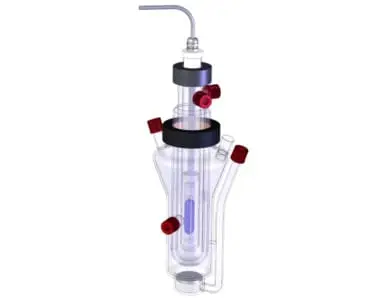
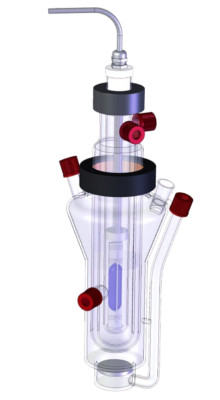
The design of the “Deep Temperature” low-temperature photoreactor is specifically engineered for the structured execution of photochemical reactions using high-efficiency UV emitters at temperatures as low as -80°C. The system must be submerged in a cooling medium within a Dewar flask to reach the reaction temperature. The emitter is located in the central axis, surrounded by a cooling jacket that is insulated from the medium by a second jacket of special construction.
The standard reactor features a glass frit for gas introduction to achieve system agitation, although it can also be supplied with an Archimedes screw mixer.
A reflux condenser filled with coolant cools the gas-liquid flow. This can be made inert through the introduction of dry ice or by using a feed tube with cryostats. The spiral shape of the inner tube helps cool the vapor coming from the reaction vessel and returns the condensate to it. This condenser is equipped with a threaded connection that can be used to attach a feed tube or a funnel. Other options are also available.
This setup allows for chemical activities of approximately 0.2 mol/h with a quantum yield less than or equal to 1, and viscosities up to 500 cP.
The possibility of using a wide range of UV lamps (low-pressure mercury, medium-pressure mercury, or xenon) allows for precise selection of the spectral range to be used in the reaction.
Emitters that can be used: