
Batch reactors or batch-type systems face their main drawback in the lack of precise temperature control. Additionally, photon penetration depth can be limited by changes in the medium’s absorbance, meaning that achieving optimal reaction conditions is not always straightforward.
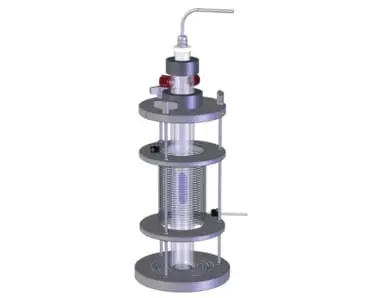
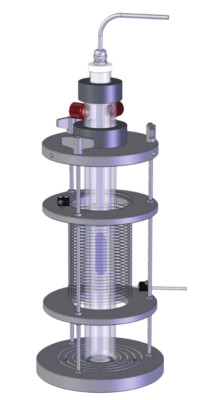
The «Tube» tubular or loop photoreactor was developed by UV-Consulting Peschl Gmbh in 1995 as part of a pharmaceutical process development in Basel (Germany) and belongs to the group of so-called microreactors. They basically consist of a UV (Ultraviolet) transparent fluorinated polymer tube through which the liquid to be irradiated circulates. This tube is coiled around a thermally insulated support and irradiation system. The tubing can have various diameters and lengths and can be wound in several layers, provided the transmittance allows it.
This tubular photoreactor operates continuously until the reaction is complete. This implies that reaction kinetics can be optimally adjusted and controlled, while also being precisely analyzed throughout the entire circuit. This feature, combined with its continuous mode operation, makes the optimization of existing photochemical processes relatively simple. For example, the potential emergence of by-products due to over-irradiation can be studied and located without great difficulty.
The main advantages of this design compared to flat-plate microreactors lie in the fact that all emitted photons have access to the reaction medium and that the flow channels can be cleaned or replaced with extreme ease. Similarly, the selection of tube diameter and the associated adjustments for the optical section or flow represent an advantage when a wide range of reactions is desired (multipurpose continuous flow).
Scaling is not done as in other cases by increasing the reactor size, but by increasing the number of reactors until the desired production volume per unit of time is reached (numbering-up). Consequently, the use of these reactors in industrial processes has considerable limitations and is primarily intended for basic research to prevent errors in subsequent industrial-scale processes.
Emitters that can be used: